
How much does a busbar machine cost in 2026?
For most buyers, the answer depends on what they actually need to produce. A compact hydraulic machine for occasional punching, cutting and bending is fundamentally different from a CNC busbar processing system designed for continuous switchgear production.
As a general planning reference, busbar processing equipment can range from a few thousand US dollars for basic hydraulic machines to tens of thousands of dollars for CNC equipment. A fully automated busbar production line with automatic storage, feeding, punching, shearing, bending and factory software integration is normally quoted on a project basis.
The machine price is mainly determined by:
• Busbar size and material
• Processing functions
• CNC and servo configuration
• Production capacity
• Tooling
• Automation level
• Material handling
• Software integration
• Installation and technical support
This guide explains the major busbar machine price categories in 2026 and how switchgear and electrical equipment manufacturers can evaluate the real cost of a busbar processing solution.
Busbar Machine Price at a Glance
The following ranges are intended for budget planning only. They are not Leaderfeng quotations.
| Busbar Machine Type | Indicative Market Range | Typical Application |
|---|---|---|
| Portable / basic hydraulic busbar machine | US$1,000–5,000+ | Maintenance and low-volume processing |
| 3-in-1 hydraulic busbar processing machine | US$4,000–12,000+ | Small and medium workshops |
| CNC busbar bending machine | US$10,000–30,000+ | Precision and repeatable bending |
| CNC punching and shearing machine | US$10,000–50,000+ | Medium- to high-volume production |
| CNC punching + bending solution | US$30,000–100,000+ | Industrial busbar production |
| Fully automated busbar production line | Project-based | High-volume automated factories |
Actual quotations can vary substantially according to machine capacity, configuration, tooling, automation and customization.
For this reason, buyers should not compare busbar machines based on purchase price alone.
A better comparison is:
Machine Price + Production Capacity + Labor Requirement + Material Utilization + Automation + Long-Term Operating Cost
1. What Determines the Price of a Busbar Processing Machine?
Two products can both be called a “busbar processing machine” while having completely different capabilities.
A conventional hydraulic machine may require operators to manually position the copper bar for punching, cutting and bending.
By contrast, a modern CNC busbar processing machine can use servo-controlled positioning, automatic feeding and programmed processing to reduce repetitive manual operations.
The major price factors include:
• Maximum copper or aluminum busbar width
• Maximum material thickness
• Punching and shearing force
• Bending capacity
• Number of CNC axes
• Positioning accuracy
• CNC control system
• Servo system
• Automatic feeding
• Tooling capacity
• CAD/CAM software
• Automatic material storage
• MES/ERP integration
• Installation and commissioning
• Operator training
• After-sales support
Therefore, the right question is not simply:
“What is the cheapest busbar machine?”
It should be:
“What machine configuration can achieve my required production capacity at an acceptable cost per finished busbar?”
2. How Much Does a 3-in-1 Busbar Machine Cost?
A 3-in-1 busbar processing machine combines three fundamental processes:
Punching + Cutting + Bending
This makes it a practical entry-level solution for electrical panel manufacturers, switchgear workshops and companies with relatively low or medium busbar production volumes.
In 2026, basic and mid-range 3-in-1 hydraulic machines can generally be found in the market from approximately:
US$4,000–12,000+
Higher-capacity or servo-controlled configurations can cost more.
Leaderfeng offers a 3-in-1 Siemens Hydraulic Busbar Processing Machine for punching, shearing and bending copper and aluminum busbars.
Different configurations are available depending on the required busbar dimensions and processing force.
For example, Leaderfeng’s current hydraulic series includes configurations covering different maximum busbar widths and thicknesses, allowing buyers to select a machine according to their actual material specifications instead of purchasing unnecessary capacity.
When does a 3-in-1 machine make sense?
A 3-in-1 machine is generally suitable when:
• Production volume is low or medium
• Operators can manually load the busbar
• Factory space is limited
• Punching, cutting and bending are all required
• Initial investment is an important consideration
• Full production automation is not necessary
For manufacturers processing larger volumes every day, dedicated CNC machines may provide better productivity.
3. How Much Does a CNC Busbar Punching and Shearing Machine Cost?
A dedicated CNC busbar punching and shearing machine is designed for higher production volumes and greater processing consistency.
Depending on configuration, CNC punching and shearing machines may fall into a broad planning range of approximately:
US$10,000–50,000+
Advanced configurations can exceed this range.
The price is influenced by:
• Maximum busbar size
• Punching force
• Number of tooling stations
• Number of CNC axes
• Servo positioning system
• Automatic feeding
• Processing speed
• Positioning accuracy
• Control system
• Software capabilities
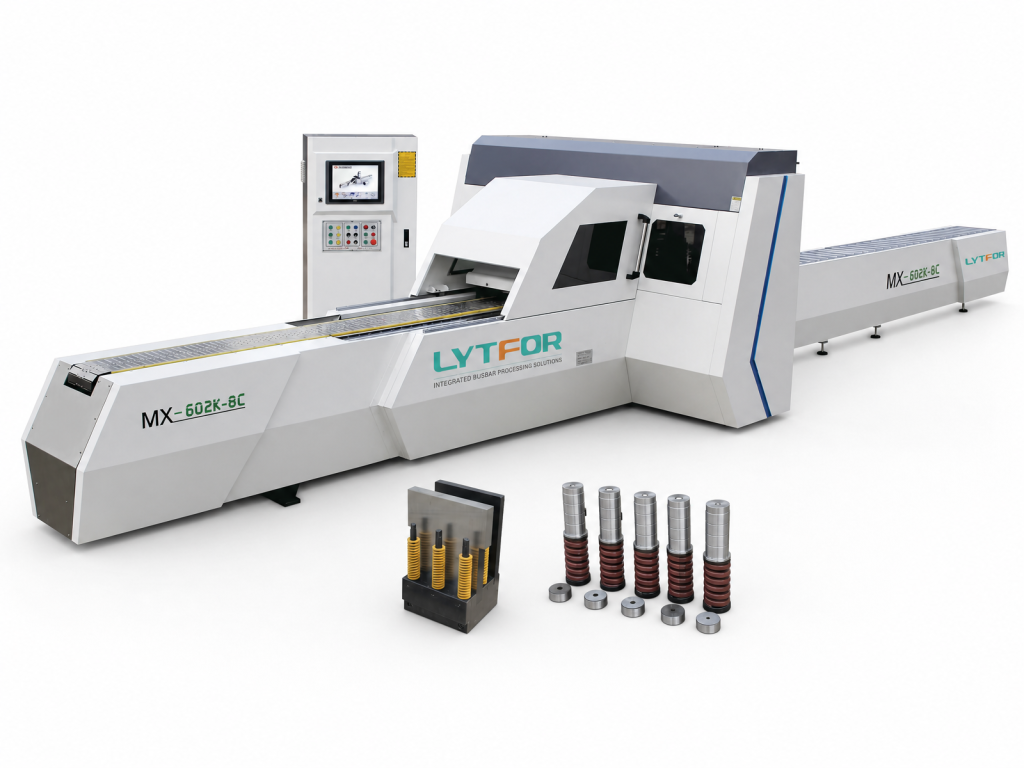
Leaderfeng’s current CNC punching and shearing system is designed for automatic punching, marking and shearing of copper and aluminum busbars.
The MX602K-7/8C configuration provides:
Up to 80 m/min positioning speed
±0.2 mm punching accuracy
6-axis CNC control
Zero-waste shearing design
Standard configurations can process busbars up to 16 × 200 mm, while customized configurations such as 10 × 250 mm are available depending on the required application.
For high-volume production, these specifications matter because machine price should be compared against throughput, material utilization and operator requirements, rather than purchase price alone.
4. How Much Does a CNC Busbar Bending Machine Cost?
Busbar bending can become a major bottleneck when production volumes increase or when many different bending dimensions are required.
A dedicated CNC servo busbar bending machine is designed to improve repeatability and reduce dependence on manual measurement and adjustment.
A general 2026 planning range for this type of equipment is approximately:
US$10,000–30,000+
The actual cost depends on:
• Maximum busbar width and thickness
• Bending force
• Servo system
• CNC controller
• Positioning accuracy
• Bending tooling
• Software
• Automation requirements
Leaderfeng’s NC.40ZB-1200/2000 CNC Servo Busbar Bending Machine is designed for precision bending of copper and aluminum busbars.
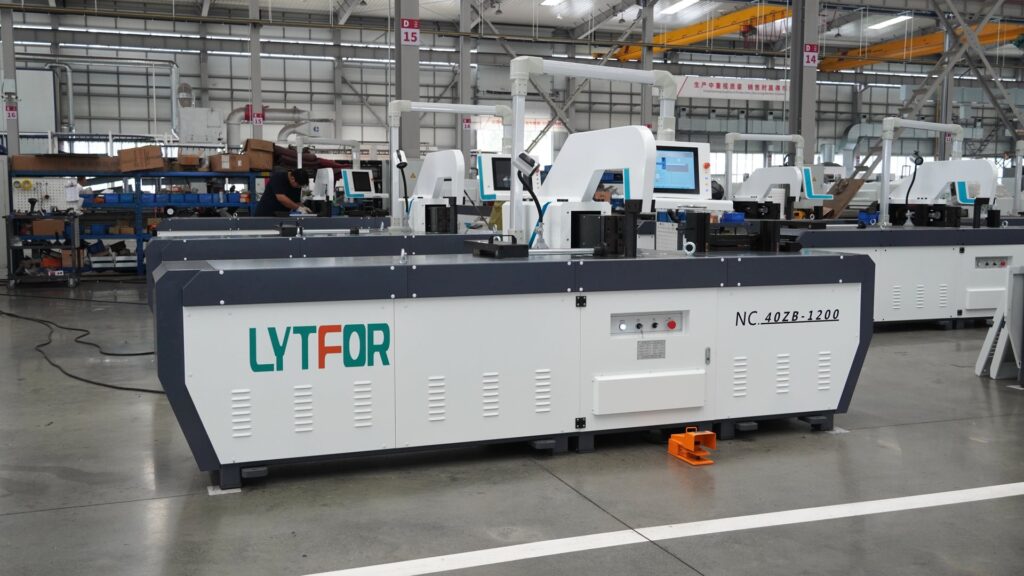
Depending on configuration, it can process flat bending dimensions up to 16 × 160 mm or 16 × 200 mm, with bending accuracy specified at approximately ±0.3°.
The machine integrates a Beckhoff CNC control system.
For buyers evaluating the control architecture itself, Beckhoff provides technical information about its TwinCAT CNC platform and CNC motion-control capabilities.
[External Link: “Beckhoff TwinCAT 3 CNC” → Beckhoff official website]
This is particularly relevant when comparing a conventional hydraulic machine with a CNC-controlled production system: part of the additional investment is in motion control, automation and repeatable positioning rather than simply the mechanical structure.
5. How Much Does an Automated Busbar Production Line Cost?
Once material storage, automatic feeding and multiple processing operations are connected, fixed online prices become much less useful.
A typical automated busbar production workflow may include:
Material Storage → Automatic Selection → Feeding → Positioning → Punching → Marking → Shearing → Bending → Finished-Part Handling
Leaderfeng provides solutions ranging from standalone machines to integrated automated busbar production systems.
One important component is the automatic busbar storage and feeding system.
Leaderfeng’s current storage and transport solutions include:
• Cantilever racks
• Horizontal conveyors
• Card-type tower racks
• Gantry crane storage systems
The system can be configured from semi-automatic to fully automatic according to production requirements and available workshop space.
More advanced configurations can integrate storage management, automatic material selection and feeding directly with the CNC punching and shearing machine.
This changes the economics of the project significantly.
Instead of purchasing an individual machine, the buyer is investing in an integrated manufacturing system.
For that reason:
Fully automated busbar production lines should normally be quoted on a project basis.
6. Busbar Size Has a Major Impact on Machine Price
One of the first questions a manufacturer will ask when preparing a quotation is:
What is the maximum busbar size you need to process?
A machine processing a 100 × 10 mm copper busbar does not require the same mechanical structure, tooling or force as a machine processing a 200 × 16 mm busbar.
Before requesting a quotation, prepare at least:
Material: Copper / Aluminum
Maximum width: ___ mm
Maximum thickness: ___ mm
Maximum length: ___ mm
You should also provide representative busbar drawings whenever possible.
This allows the manufacturer to evaluate punching, shearing and bending requirements more accurately.
7. Production Volume Changes the Economics
Consider two factories.
Factory A produces relatively small batches of customized electrical panels.
Factory B manufactures large quantities of switchgear every day.
They should not necessarily purchase the same machine.
For Factory A, a 3-in-1 busbar processing machine may offer a better balance between investment and flexibility.
For Factory B, separate CNC punching/shearing and CNC bending machines may provide higher throughput and better production consistency.
As production volume increases, factors such as operator time, positioning speed, scrap, rework and material handling become increasingly important.
This is why machine price should eventually be translated into:
Cost per Finished Busbar
rather than evaluated only as initial capital expenditure.
8. Automation Level Can Change the Price Significantly
Automation is one of the largest variables in busbar machine pricing.
A basic production workflow may look like:
Manual Storage → Manual Loading → Processing → Manual Transfer → Manual Bending
A more automated workflow can become:
Automatic Storage → Automatic Material Selection → Automatic Feeding → CNC Punching/Shearing → Digital Production Data → CNC Bending
Leaderfeng’s automated solutions can also support digital workflows involving systems such as:
MES, ERP, PLM and WMS
depending on project requirements.
The additional investment should therefore be evaluated against potential reductions in:
• Manual material handling
• Repetitive positioning
• Production errors
• Material waste
• Work-in-process time
• Production bottlenecks
9. CNC Control System and Software
The control system is another important component of machine cost.
Industrial CNC systems can provide more advanced motion coordination, positioning and programming capabilities than basic manual or PLC-based equipment.
Leaderfeng uses Beckhoff CNC technology in its automated busbar processing solutions.
[External Link: “Beckhoff CNC technology” → Beckhoff official website]
Beckhoff’s TwinCAT CNC platform supports CNC motion control, configurable axes and CNC channels, as well as integration with PLC-based automation environments.
For a buyer, the important point is not simply the controller brand.
You should evaluate whether the machine’s control architecture can support your future production requirements.
Questions worth asking include:
• Can drawings be imported digitally?
• Can multiple machines share production data?
• Can production information connect to MES or ERP?
• Can the system be expanded later?
• Can automatic material storage be added?
These questions become especially important when purchasing equipment for a new automated factory.
10. Tooling Can Change the Final Machine Cost
When comparing quotations, check exactly what tooling is included.
For example:
• How many punching dies are supplied?
• Which hole diameters are included?
• Are bending dies included?
• Is embossing tooling included?
• What does an additional die cost?
• How quickly can replacement tooling be supplied?
Leaderfeng’s hydraulic 3-in-1 machines, for example, can be supplied with punching, cutting and different bending tooling according to machine configuration.
A quotation that appears cheaper initially may become more expensive if important tooling must be purchased separately.
11. Machine Price vs. Total Cost of Ownership
For industrial equipment, the purchase price is only one part of the investment.
A more useful formula is:
Total Cost of Ownership = Machine Price + Tooling + Shipping + Installation + Training + Maintenance + Labor + Energy + Material Waste + Downtime
Five factors deserve particular attention.
Labor
How many operators are required to run the process?
Automatic feeding and positioning can reduce repetitive operator tasks.
Material Waste
Copper represents a significant material cost in busbar production.
Improving material utilization and reducing incorrect cuts can therefore influence the economics of the machine over its service life.
Rework
Incorrect punching positions or bending dimensions may require a busbar to be reworked or scrapped.
CNC-controlled positioning can help improve consistency across production batches.
Throughput
A lower-cost machine may meet today’s production requirements but become a bottleneck when order volume increases.
Downtime
Technical support, spare-parts availability, remote diagnostics and operator training should also be considered when comparing suppliers.
12. What Type of Busbar Machine Should You Choose?
The following table provides a simple starting point.
| Production Requirement | Suggested Machine Type |
|---|---|
| Occasional processing / maintenance | Portable busbar machine |
| Small-batch production | Hydraulic 3-in-1 busbar machine |
| Medium production | Servo 3-in-1 or dedicated CNC machine |
| Medium/high-volume punching and cutting | CNC punching & shearing machine |
| Precision bending | CNC servo bending machine |
| High-volume switchgear production | CNC punching/shearing + CNC bending |
| Automated factory | Automated busbar production line |
| Automated material management | Automatic busbar storage & feeding system |
For companies manufacturing switchgear, the required production capacity, busbar dimensions and downstream assembly process should be considered together.
The IEC 61439 series is also an important international reference for low-voltage switchgear and controlgear assemblies. IEC 61439-1 establishes general rules, while IEC 61439-2 addresses power switchgear and controlgear assemblies.
[External Link: “IEC 61439-1” → International Electrotechnical Commission]
[External Link: “IEC 61439-2” → International Electrotechnical Commission]
These standards relate to the finished electrical assemblies rather than specifying a particular busbar processing machine, but they provide useful context for manufacturers working in the switchgear industry.
13. What Information Is Needed for an Accurate Busbar Machine Price?
Instead of sending only:
“Please send me your busbar machine price.”
provide the following information:
- Busbar material: copper or aluminum
- Maximum width
- Maximum thickness
- Maximum length
- Typical drawings
- Required operations
- Hole sizes and shapes
- Daily or monthly production volume
- Required automation level
- Factory voltage
- Destination country
- MES/ERP integration requirements
- Available workshop space
With this information, the engineering team can determine whether you need:
a 3-in-1 machine, dedicated CNC machines or a complete automated busbar production line.
Frequently Asked Questions
How much does a busbar processing machine cost?
Busbar processing machines can range from a few thousand US dollars for basic hydraulic equipment to tens of thousands of dollars for industrial CNC machines. Fully automated busbar production systems are normally priced according to the required configuration.
How much does a 3-in-1 busbar machine cost?
As a general 2026 market planning range, conventional hydraulic 3-in-1 busbar machines may cost approximately US$4,000–12,000 or more. Capacity, tooling, controller and automation can significantly affect the final quotation.
Why is a CNC busbar machine more expensive?
CNC machines typically include servo positioning, CNC control, digital programming and more automated processing functions. These systems are designed to reduce manual positioning and improve repeatability and throughput.
Is a CNC busbar machine worth the additional cost?
It depends on production volume, labor costs, processing complexity and automation requirements. For medium- and high-volume production, buyers should compare cost per finished busbar and total cost of ownership rather than initial machine price alone.
What is the price of a fully automatic busbar production line?
There is no universal fixed price. Automated busbar lines are normally engineered according to busbar dimensions, production capacity, processing operations, material storage, automatic feeding and software integration requirements.
Can one machine punch, cut and bend busbars?
Yes. A 3-in-1 busbar processing machine combines punching, cutting and bending in one workstation. For higher production volumes, manufacturers may use dedicated CNC punching/shearing and CNC bending machines.
Can busbar machines process both copper and aluminum?
Yes. Leaderfeng offers machines for processing copper and aluminum busbars. The appropriate configuration depends on material dimensions and required operations.
Can a busbar production line connect with MES or ERP?
Yes. Leaderfeng automated busbar solutions can support integration with MES, ERP and other production-management systems depending on project requirements.
Get an Accurate Busbar Machine Price
There is no single busbar machine price that applies to every factory.
The appropriate investment depends on:
Busbar Size + Processing Requirements + Production Volume + Automation Level + Factory Workflow
Leaderfeng provides busbar processing solutions ranging from hydraulic 3-in-1 machines to CNC punching and shearing machines, CNC servo bending machines, automatic storage systems and integrated busbar production solutions.
If you are planning a new busbar production line or upgrading an existing switchgear factory, send us your:
Busbar drawings + maximum width and thickness + production volume + required processing operations.
Our engineering team can evaluate the application and recommend an appropriate machine configuration.
