
Choosing a busbar processing machine is not simply a matter of comparing machine prices or technical specifications.
For switchgear, transformer, electrical panel and power equipment manufacturers, the more important question is:
Which busbar processing configuration best matches your production volume, busbar dimensions, product variety and automation requirements?
A small workshop producing customized electrical panels may need a very different solution from a switchgear factory processing hundreds of copper busbars per shift.
In this guide, we compare three common solutions:
- 3-in-1 busbar processing machines
- CNC busbar punching, shearing and bending machines
- Automated busbar production lines
The goal is to help manufacturers determine which level of automation provides the best balance between investment, productivity and long-term operating cost.
1. Start With Your Production Requirements
Before comparing machines, define your actual production conditions.
The most important factors include:
Busbar material
Most electrical manufacturers process copper and aluminum busbars. Machine configuration, tooling and processing parameters should therefore be selected according to the material being processed.
Maximum busbar dimensions
Determine the maximum width and thickness of the busbars used in your products.
For example, Leaderfeng’s CNC punching and shearing solutions can be configured for busbars up to 16 × 200 mm, with customized configurations available for applications such as 10 × 250 mm.
Required operations
Consider whether production requires:
Punching
Shearing
Marking
Flat bending
Vertical bending
Twist bending
Chamfering
Not every factory needs every process.
Production volume
This is one of the most important factors.
A machine suitable for 20–50 customized busbars per day may become a bottleneck when production increases to hundreds of parts per shift.
2. Option One: 3-in-1 Busbar Processing Machine
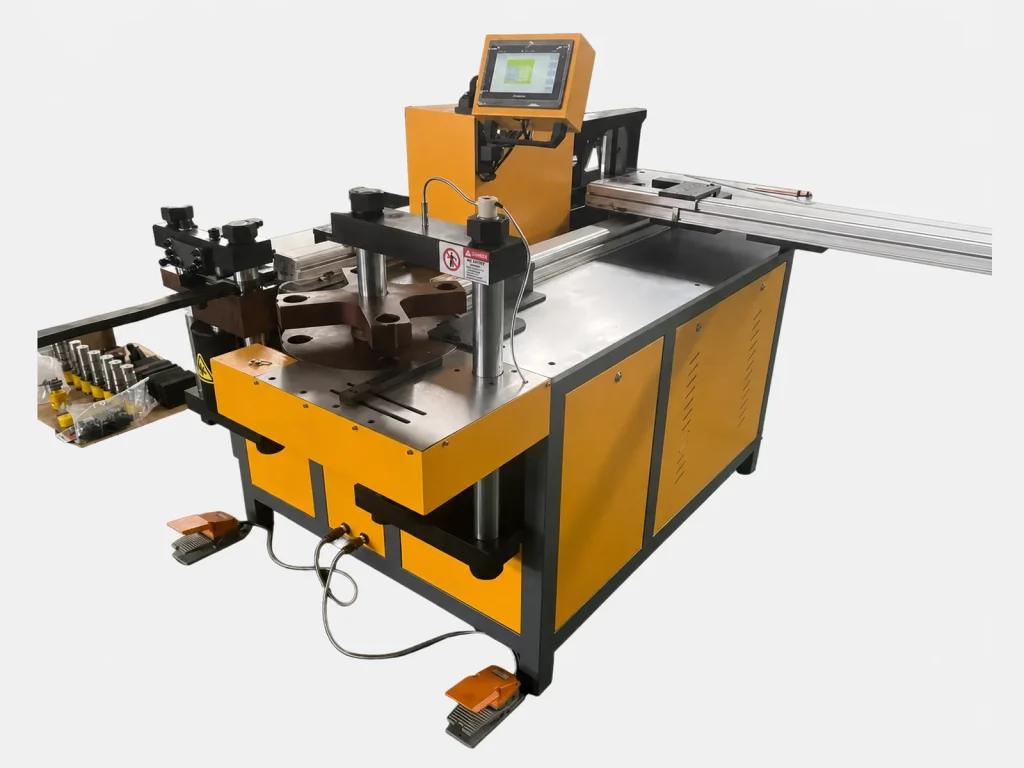
A 3-in-1 busbar machine combines three fundamental operations:
Punching + Cutting + Bending
into one compact machine.
This configuration is particularly useful for manufacturers producing relatively small batches or frequently changing busbar designs.
Best suited for:
Electrical panel workshops
Small and medium switchgear manufacturers
Maintenance departments
Project-based production
Low-to-medium production volumes
Main advantages
The biggest advantage is flexibility.
Instead of purchasing three separate machines, manufacturers can perform the major busbar fabrication processes from a single workstation.
This reduces:
Initial equipment investment
Required workshop space
Machine installation complexity
Servo-controlled configurations can also provide automatic positioning and parameter storage, reducing the need for manual marking and repeated setup. Leaderfeng’s Siemens servo configuration, for example, uses independent servo control for punching, cutting and bending operations.
Main limitation
The limitation appears when production volume increases.
Because punching, cutting and bending share the same workstation, operators must move between different processing operations.
For high-volume manufacturing, this can restrict throughput.
Recommended when: flexibility and lower initial investment are more important than maximum production speed.
3. Option Two: Separate CNC Punching & Shearing + CNC Bending
For medium- and high-volume busbar manufacturing, separating punching/shearing and bending is usually more efficient.
A typical configuration consists of:
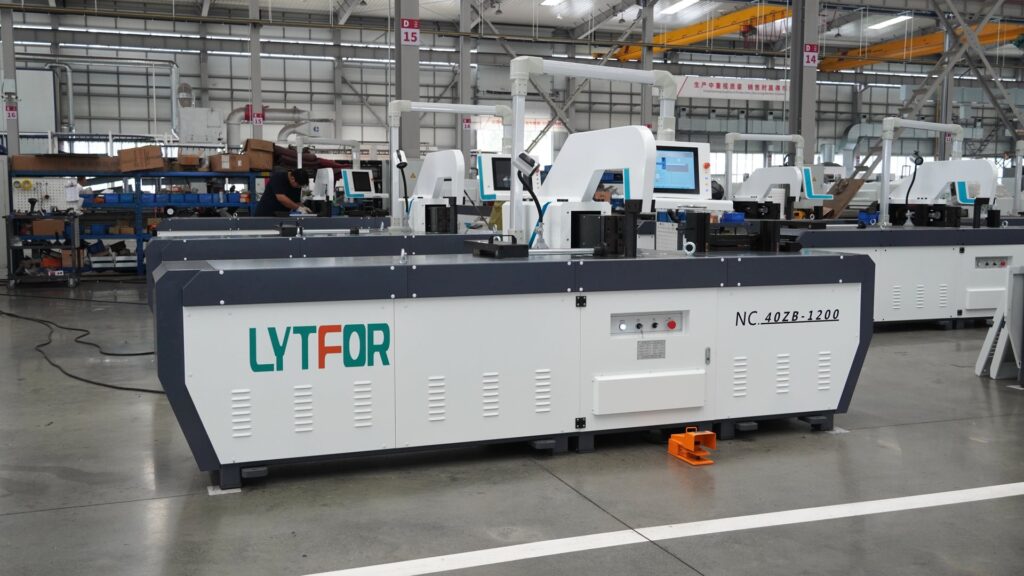
CNC Busbar Punching & Shearing Machine
CNC Servo Busbar Bending Machine
Instead of completing all operations at one workstation, punching/shearing and bending can operate simultaneously.
This significantly improves production flow.
CNC Punching & Shearing
The punching and shearing machine automatically handles:
Feeding
Positioning
Punching
Marking
Shearing
Leaderfeng’s MX602K series, for example, provides positioning speeds up to 75 m/min, punching accuracy of ±0.2 mm, six-axis CNC control and automatic processing of copper and aluminum busbars.
This reduces dependence on manual measuring and positioning.

CNC Servo Bending
After punching and cutting, the prepared busbar moves to the bending station.
The NC.40ZB CNC servo bending series provides:
±0.3° bending accuracy
±0.15 mm positioning accuracy
and processing capacity up to 16 × 200 mm, depending on configuration.
This configuration is better suited to manufacturers that require repeatable quality across larger production batches.
Best suited for:
Switchgear manufacturers
Transformer manufacturers
Electrical panel factories
Busduct manufacturers
Power distribution equipment manufacturers
Medium-to-high-volume production
Recommended when: production efficiency, repeatability and scalable capacity are more important than minimum initial investment.
4. Option Three: Automated Busbar Production Line
When production volume becomes large enough, simply purchasing faster machines is not always the solution.
The next bottleneck is often material handling.
Operators still need to:
Find the correct copper bar
Transport material
Load the machine
Identify specifications
Move processed parts between stations
These operations do not directly add value to the finished busbar.
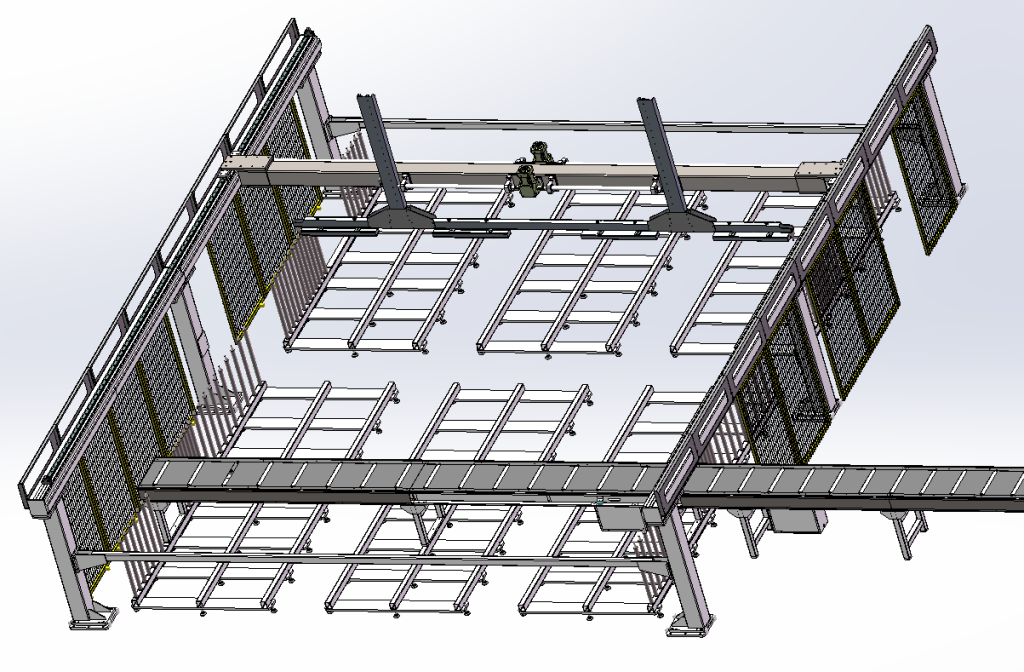
An automated busbar production system therefore focuses on connecting:
Material Storage → Automatic Feeding → CNC Punching & Shearing → CNC Bending → Production Data
into a more integrated workflow.
Leaderfeng’s current automation solutions can combine CNC processing equipment with busbar storage and feeding systems, while digital programming can connect production information with ERP, PLM, MES and WMS environments depending on project requirements.
Best suited for:
Large switchgear factories
High-volume electrical equipment manufacturers
Factories with high labor costs
Multi-shift production
Smart factory projects
Manufacturers expanding production capacity
The objective is not simply to make each individual machine faster.
It is to reduce the amount of non-processing time between operations.
5. CNC vs. 3-in-1 vs. Automated Line: Quick Comparison
| Requirement | 3-in-1 Machine | Separate CNC Machines | Automated Line |
|---|---|---|---|
| Initial investment | Lower | Medium | Higher |
| Floor space | Low | Medium | Higher |
| Production volume | Low–Medium | Medium–High | High |
| Flexibility | High | High | Medium–High |
| Manual handling | Higher | Medium | Low |
| Production consistency | Medium–High | High | High |
| Automation level | Low–Medium | High | Very High |
| Expansion potential | Medium | High | Very High |
There is no universally “best” busbar machine.
The correct choice depends on how the factory actually produces busbars.
6. When Should You Upgrade From a 3-in-1 Machine?
A 3-in-1 machine does not automatically become obsolete when production grows.
However, manufacturers should consider moving toward dedicated CNC equipment when several problems begin appearing.
Production cannot keep up with assembly
If switchgear or electrical panel assembly is waiting for processed busbars, the busbar workstation has become a production bottleneck.
Too much manual measuring and marking
Manual positioning increases labor requirements and creates opportunities for dimensional errors.
Batch consistency becomes difficult
As order quantities increase, maintaining consistent hole positions, cutting lengths and bending angles becomes increasingly important.
Skilled operators become difficult to find
CNC positioning and stored processing programs can reduce dependence on operator experience.
Material movement consumes too much time
When employees spend significant time locating, transporting and loading copper bars, storage and automatic feeding should become part of the automation discussion.
7. Calculate ROI, Not Just Machine Price
One common purchasing mistake is comparing machines only by purchase price.
A better evaluation considers:
Total production cost per finished busbar.
This includes:
Machine investment
Operator requirements
Material waste
Setup time
Processing time
Rework
Downtime
Material handling
Maintenance
For example, a more automated machine may require a higher initial investment but reduce manual positioning, repeated measurement and material handling during every production shift.
Over several years of operation, these savings can become more important than the initial machine price.
8. What Information Should You Send to a Busbar Machine Manufacturer?
To receive an accurate machine recommendation, avoid sending only:
“Please send your busbar machine price.”
Instead, provide:
1. Busbar material: Copper / Aluminum
2. Maximum width: ___ mm
3. Maximum thickness: ___ mm
4. Required processes: Punching / Cutting / Bending / Chamfering
5. Typical drawings: PDF / DXF / CAD
6. Daily or monthly production volume: ___ pieces
7. Current production method: Manual / Hydraulic / CNC
8. Automation requirement: Standalone / Semi-automatic / Fully automated
This information allows the machine manufacturer to evaluate the complete production process instead of simply quoting a standard machine.
9. Which Busbar Processing Solution Is Right for Your Factory?
A simple rule can help narrow the choice:
Low-volume + high product variety
→ Choose a 3-in-1 busbar processing machine.
Medium/high-volume + repeatable production
→ Consider CNC punching & shearing + CNC servo bending.
High-volume + high labor cost + smart manufacturing requirements
→ Evaluate an automated busbar production line with storage and feeding.
For manufacturers planning future expansion, it is also important to consider whether today’s equipment can become part of tomorrow’s automated production system.
The lowest-cost machine today is not always the lowest-cost production solution over the next five years.
10. Get a Busbar Processing Solution Based on Your Production Data
Every busbar factory has different production requirements.
Leaderfeng provides busbar processing solutions ranging from flexible 3-in-1 machines to CNC punching, shearing, servo bending, chamfering and automated storage and feeding systems. The company’s current CNC product range is designed around copper and aluminum busbar processing for switchgear, transformer and electrical equipment manufacturing.
Instead of choosing a machine based only on specifications, evaluate the complete production workflow.
Send us your busbar drawing, maximum material dimensions and expected production capacity. Our engineers can evaluate your current process and recommend an appropriate machine configuration.
